


Planning and completing doctoral studies
Doctoral studies are centered around one’s doctoral thesis and scientific research. Doctoral studies are regulated by the University of Tartu’s Regulations for Doctoral Studies, which include general requirements for supervision, individual planning, and application for a doctoral degree. Doctoral students should also get acquainted with good practices of the University of Tartu, especially good practices of doctoral studies.
This page compiles faculty guidelines and recommendations for the following topics:
- planning your studies,
- compiling and completing your individual plan and period plan,
- progress reviews,
- writing the introductory chapter,
- applying for a doctoral degree.
Planning your studies
In planning their studies, the doctoral candidate makes individual and purposeful choices about specific activities in cooperation with their supervisor(s), and provides a detailed timeline of planned activities in their individual study plan. Activities necessary for professional development and for the completion of the doctoral thesis can be pursued through university courses, events organised by the doctoral schools or the centre for doctoral studies, and through external events – both local and international. Courses related to a specific specialty vary and each specialty has provided a list of compulsory and/or optional courses.
In the Faculty of Social Sciences you can complete doctoral studies in two doctoral programmes. Read more about the specialties, their structure and compulsory courses.
The following illustration offers recommendations on which transferable skills to focus on at different stages of the doctoral studies, in addition to some activites supporting general development. The guidelines are based on the learning outcomes of the doctoral programs in the faculty, which must be achieved in order to complete the program. The recommendations are exactly that: suggestions aimed at easing the planning of the studies. Based on the specificities of each thesis project, and the needs of each doctoral student, alternative sequencing of these activities is also possible. However, the compulsory course ‘Introduction to doctoral studies at the Faculty of Social Sciences’ should be taken during the first semester of studies, as it offers a broad insight into the most important topics related to doctoral studies.

Be sure to also visit the trasferable skills training homepage, which provides information on specific courses and training events realated to the required transferable skills.
Transferable Skills Training Opportunities
Individual plan and period plan
Doctoral studies are carried out according to the doctoral student's individual plan, in which the study and research plan for the entire study period is agreed upon, based on the learning outcomes of the doctoral program. The individual plan is therefore a central document in doctoral studies, which the doctoral student prepares in cooperation with the supervisor.
The individual plan consists of several parts:
- The individual plan is the doctoral researcher's research and study plan for the entire period of study. The individual plan for the whole period of doctoral studies is submitted together with the first progress review report of the first year. The individual plan is compiled in cooperation with the supervisor(s).
- The period plan is a part of the individual plan, in which the specified plan of studies and research is agreed upon for the following progress review period. The period plan of the first semester must be submitted within one month after matriculation. The following period plans must be submitted together with each progress review report.
The doctoral student's/external student’s progress in teaching and research is assessed during progress reviews based on how they have been able to progress based on their individual plan. The individual plan or period plan must also include information about any interruption of doctoral studies or academic leave, as well as circumstances that may affect the duration of studies. Read more in the Regulations for Doctoral Studies.
Depending on how one has been able to progress based on one’s individual plan,
- the doctoral candidate/external doctoral candidate is reviewed positively or negatively;
- the doctoral candidate will be assigned to full-time or part-time studies (applies only to those admitted before the 2022/23 academic year)
Doctoral candidates admitted after the 2022/23 academic year, must submit their individual plan, period plans and progress review reports in TEEK. You can find the guidelines and instructions for TEEK on the central page for planning and completing doctoral studies.
Doctoral candidates admitted before the 2022/23 academic year, must submit their individual plan, period plans and progress reviews using the .docx forms. You can find the forms on the central page for planning and completing doctoral studies.
When does the individual plan have to be submitted?
1st year doctoral candidate
- The doctoral student must compile a period plan for the first semester and enter it into the Study Information System within 30 days after matriculation.
- The doctoral student must compile the individual plan for the whole period of study and a period plan for the second semester and submit it to the progress review committee, alongside other documents required and outlined in the Procedure of progress review of learners in doctoral studies at the Faculty of Social Sciences. The documents must be entered into the Study Information System at least 8 working days before the progress review date.
Doctoral candidate of the 2nd academic year and onwards
- Together with the progress review report and other documents required by the Procedure of progress review of learners in doctoral studies at the Faculty of Social Sciences, the doctoral student has to submit the period plan for the next review period. The documents must be entered into the Study Information System at least 8 working days before the progress review date.
External doctoral candidate
- To receive the status of an external doctoral candidate in a doctoral curriculum, an application and, together with it, a draft of the period plan. The individual plan must be completed either for a semester or an academic year, depending on the period for which the external student status is being applied for. Within two weeks of being considered an external student, the external student prepares a period plan for the time allocated for studying as an external student and enters it into the study information system.
- Together with the progress review report and other documents required by the Procedure of progress review of learners in doctoral studies at the Faculty of Social Sciences the external doctoral student has to submit the period plan for the next review period. The documents must be entered into the Study Information System at least 8 working days before the progress review date.
1. Research, development and creative activities
1.1. Research activities related to the doctoral thesis and compiling the doctoral thesis; publication of the results of research, development and creative activities.
1.2 Participation in and presenting at professional events related to the doctoral thesis; international study and research experience.
1.3 Other research, development and creative activities.
Participation in organising research, development and creative acitivities, participation in the planning and imeplementation of a research project, application of the results of research, development and creative activities, cooperation with entrprises and institutions, etc. For a project, please include its main details, incl. the code, eligibility period and title.
1.4 Acquisition of transferable skills that meet the learning outcomes of the doctoral program.
Acquisition of teaching and supervisory experience, as well as collaboration and leadership skills, popularisation of the specialisation, etc. Other work that is not directly related to the doctoral thesis may take up to 20% of the total working time of a junior research fellow. Your period plan should show the amount of other work in hours.
2. Studies
Studies and self-development according to the requirements of the doctoral program. Courses, training and other activities that the doctoral student has selected to develop his/her transferable and professional skills.
- The individual plan must meet the requirements set in the Procedure of progress review of learners in doctoral studies at the Faculty of Social Sciences. When compiling the individual plan, consider how your research during the academic year will be assessed at the progress review. Of course, unexpected situations might arise, and not everything might go according to plan, but when less research has been (planned and) done than the Procedure of progress review requires, it might lead to repeat progress review or, in extreme cases, to exmatriculation.
- Your individual plan is your plan of action – consider carefully which activities you plan for the next semester/academic year.
- How the courses and research-related tasks contribute to your development during the four years of your studies.
- Plan enough activities for the semester to get a positive assessment but try to avoid overexertion and potential burnout.
- Consult your supervisor and, if necessary, the head of specialisation/programme director. Particularly at the beginning of your studies, they can help you decide how to combine studies and research and how to divide your workload.
- The individual plan is an instrument of time management – four years is a long period of time and the individual plan enables you to divide it into different work phases and set realistic deadlines for yourself. At the same time, it is essential to consider the progress of your studies as a whole, relying on the Procedure of progress review and the individual plan that has been compiled after matriculation for the whole period of study. Because of the length of your doctoral studies, skillful and consistent time management is essential. Dividing larger tasks into smaller parts and setting concrete deadlines is at the center of skillful time management.
- The individual plan forms the basis for the progress report – the doctoral student has to compare these two documents, and the review committee does the same. If the doctoral student’s activities do not correspond to the individual plan, this has to be explained and substantiated in the progress report. Research is generally not a linear process; therefore, it may be necessary to change, adjust or supplement the initial research plan.
- The individual plan and the progress review reports record the doctoral student’s development during their studies. Compile them in a way that they are of use to you later on, for writing different overviews or summaries.
Progress Review
In doctoral studies, a progress review is the assessment of a doctoral candidate’s advancement in research and coursework, carried out during a progress review meeting. During the progress review, the review committee evaluates the achievement of the learning outcomes of the doctoral programme and the fulfillment of the individual plan. Passing the review is a prerequisite for continuing doctoral studies.
In the Faculty of Social Sciences, progress reviews are regulated by the university’s Regulations for Doctoral Studies and the Procedure of progress review of learners in doctoral studies at the Faculty of Social Sciences.
Read more about the progress review
Guidelines for introductory chapter
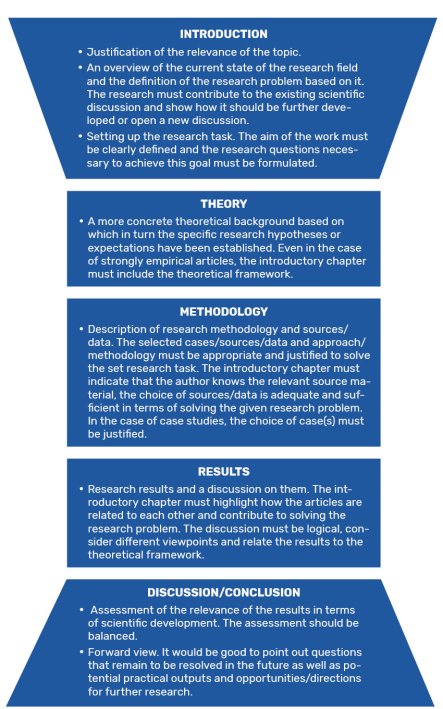
When writing a doctoral thesis as an integrated collection of research publications, it usually includes at least three research articles and an introductory chapter. The requirements for the introductory chapter can be found in paragraphs 118 and 121.6 of the Regulations for Doctoral Studies, but we have also compiled faculty level guidelines for writing said chapter.
Introductory chapter is not just a summary of the research articles; instead, it provides framing for the whole thesis, synthesizing new knowledge from the articles. In general, the chapter should follow the structure set out below, and include the following components. From a wider introduction, the author moves to the specific research question, followed by overviews of theory, methodology, and results. The discussion/conclusions section is, once again, wider, touching upon the relevance of the results on the advancement of the discipline and offering the author’s opinion on the future outlook.
Applying for a doctoral degree
Detailed rules and guidelines for applying for a doctoral degree can be found in the Regulations for Doctoral Studies. It is recommended to also get acquainted with Additional conditions for awarding doctoral degrees in the Faculty of Social Sciences.
You can find more information about receiving the diploma and the conferment procedure on the central page for planning and completing doctoral studies.
